
 Posts


I've been asked by a few people about my current plans for this blog. Personally, I'm leaning towards wrapping it into my GitHub blog at some point, but that's not particularly well-maintained either. I haven't forgotten about this outlet, I just haven't had much time to put into it and have been involved with too many other things.
I did do some very minor cleanup of the layout here today - it was a little embarrassing to look over here and see graphics announcing "upcoming events" in 2010. There probably should be some news about myself up here at some point, too...I haven't given much detail online about the ordeal that these past few years have been. I ought to put a clear accounting up somewhere of what happened, but I keep thinking I should dig myself out of the hole before risking saying something that might make it harder to get out of it. That's been a little complicated by a few rumors going around (primarily in the AFOL community), though, so I don't know what I'll do about it now.
Wednesday, July 22, 2015

Sunday, January 22, 2012
Need a New Place
It's gotten pretty clear that this arrangement on Blogger isn't working out. Among the issues I'm looking at is getting away from Google - anybody have suggestions on where my projects can go in the future? I'm aware of a few places for certain types of content (MOCpages for LEGO, RobotBox for robotics, etc), but I'd like some sort of general portfolio site as well. I've clearly failed to find the right amount of more traditional blogging to include alongside that sort of content, but I'd like a platform that encourages something of that as well.
Any suggestions?
Any suggestions?
Tuesday, May 25, 2010
Maker Faire NC recap
 The first annual Maker Faire NC was April 25th, 2010, and it was quite a success, with over 2000 people coming to see more than 50 of us showcasing various things we've made.
I ran a display called LEGO DIY, which featured original creations from myself, BrickJournal editor Joe Meno, and Brickapolis. This was my first time running a display by myself and using my own models to anchor a display (generally I'm more active in group layouts instead). You can find information on all of the creations (and the modified set) I did on the NCLUG post I wrote for the event.
I believe that all the photos and videos you could possibly want (and plenty extra to spare) can be found in the official Maker Faire:NC 2010 flickr pool. I'm gratuitously over-represented in there, but for the purposes of this blog I guess that counts as less of a bug and more of a feature. I also have three photosets of my own (I only added a handful of photos to the group pool): Maker Faire NC setup, Maker Faire NC 2010, and Scrap Exchange. The Scrap Exchange hosted the exhibitor's party on Saturday night, which was also a great opportunity for me to see all the exciting things they do there. I picked up a variety of interesting things from their barrels that you can fill bags from - some of which I was actually able to use with my LEGO pneumatics to make a quick repair during the show.
The event was well-organized, especially considering that this was the first time out. It was a great show - my only regret is not getting to see more of the other displays. I'm not sure how long they'll keep the list of exhibitors from 2010 online, but there were quite a few displays that I'm interested in looking into further. Isn't that the point? That we all want to try out some of each other's hobbies afterwards?
Word when I left that night was that they'd start looking for another location in Durham for Maker Faire NC 2011 within the month. Since I will probably be involved again in some way or another (I might do a similar display again, might get a proper NCLUG group display going, or might opt to go the musical performance route with my Mindstorms band instead), I will keep you posted.
Friday, May 14, 2010
This Exists
 This (an all silver Rubik's cube where the boxes are all different dimensions) exists. I need one, if only to make my little corner of the world a happier place.
That is all.
Wednesday, May 12, 2010
What I Was Doing Mother's Day Weekend
For a glimpse of how BrickMagic went on Mother's Day weekend, check out the BrickMagic flickr pool (all of my ~500 photos have been added here).
I'm also one of the 11 builders featured by name in this wrap-up at motherboard.tv.
I don't intend to do a full recap - since this was the first year this event was put on, the negative stuff will be sent to Joe sooner or later as feedback and chalked up as lessons learned. Many of the highlights aren't things we can share much of (set designers showing us prototypes, private info on the idea house, etc). I'm told that some video was taken for the BrickJournal website, but I have no what (if anything) will surface. Time will tell. I need to move on to the next thing now.
Monday, May 3, 2010
Neglecting this for a few days...
Just a head's up as to what's going on - I know I need to revisit a few topics from the past few weeks, but nothing additional will be done here until well after BrickMagic. Sorry for the inconvenience, but there are only so many hours in the day and I cannot prioritize this now.
Thursday, April 29, 2010
From the Maker of the Barrel Monster
Recap posts of the past few days are coming, but first, here's an exciting piece of art I accidentally saw on Saturday. This "Street Knight" was built by Joe Carnevale of Barrel Monster fame. Apparently it was installed Saturday morning as an Earth Day festivity (you have to love the recycled art tone of it). In any case, it's spectacular and you can appreciate it even with a quick drive by (it's on a street corner in the Cameron Village mall, and I was able to admire it for a minute while I was sitting at the red light on my way to Maker Faire NC from the NCLUG meeting).
Here are a few links to news coverage (with any luck at least one of them will keep the page live for a while):
WRAL
News & Observer
Raleigh Telegram
Green Diary
This is apparently not a permanent exhibit, that last link indicates plans to sell it to a "local" (I'm assuming Raleigh-area) gallery in the next few weeks if a permanent location at Cameron Village cannot be found.
Sunday, April 25, 2010
Maker Faire NC
Maker Faire NC is TODAY from 9 AM to 9 PM, in Durham, North Carolina. Additional details on my display at http://www.nclug.us/index.php/2010/04/maker-faire-nc-this-weekend/
Display set-up photos at http://www.flickr.com/photos/dp3/sets/72157623802813275/
Display set-up photos at http://www.flickr.com/photos/dp3/sets/72157623802813275/
Friday, April 23, 2010
Minifig-scale Desk
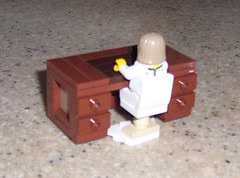 Here's another small project I built fairly recently: a minifig-scale LEGO desk. Most of the parts for this were taken from a copy of the Crystal Skull temple Indiana Jones kit. The photos didn't come out well (I rushed photos of quite a few things so I'd have more links ready for Maker Faire NC), but the desk itself is a design I'm happy with. Note that the dark tan tiles are set back a tile's thickness from the frame of the desk. I'm also happy with the blotter and the drawer pulls. A great use of that small amount of dark brown and dark tan you can't build much with!
Pretty much everything done in this desk has been done elsewhere - the techniques aren't particularly complex, but they work well.
Modifying LEGO Set 8880
LEGO set 8880, the Technic Supercar, is one of the greatest LEGO sets of all time (you can argue otherwise, but you would be wrong). When I finally bought mine on eBay (you can buy used copies in decent shape there for roughly the original retail price), mine had a few parts that were incorrect. Since an incomplete set can't really hold up as a collectible, I went ahead and started modding mine. The obvious things to change were places where other parts are more appropriate, but didn't exist back in 1994. So I focused on a few changes, based on newer parts (and preserving the look and feel of the set as much as possible):
1. Allow the suspension to use more of the large springs' shafts.
2. Secure the steering to prevent half-bushings from falling off (a minor issue normally, exaggerated by change #1).
3. Expand the wheel wells so that the wheels never get stuck (this worked in the original it but change #1 broke it).
4. Add a Power Functions motor (motorizing this kit is generally considered impossible).
The suspension and steering came out well. The motor only works in second gear, and even then I had to keep the trunk open for it and sturdy up an axle (the chain for the engine is the weak link). Change #3 does make the front of the car visibly less smooth, but functionally is fine. Long story short: I need to design my own supercar from scratch one of these days.
More details on flickr, along with a display idea (put the car "up on blocks" and use a mirror underneath to make more of the internals visible).
Thursday, April 22, 2010
9V Thomas the Tank Engine
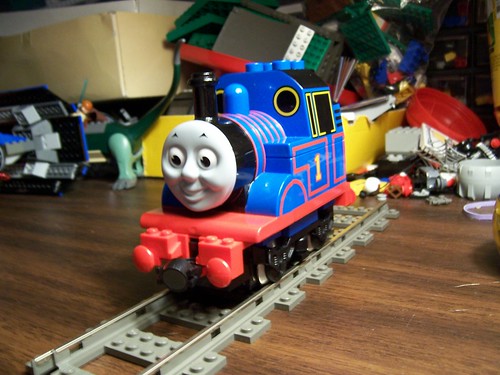
My 9V Thomas the Tank Engine model has gone unblogged for no apparent reason. The photos sort of speak for themselves in this case, but here's a blog post for it. The photos are on flickr (with an outdated tongue-in-cheek description), and yes, this model will be at Maker Faire NC this weekend.
Saturday, April 17, 2010
Test Post
Testing out some layout changes...
Looks like the new layout is loading reasonably well in IE 8, Firefox 3.6.3, and Chrome (in spite of a typo I had earlier that broke it in Firefox). Time to stop messing with it.
I'm planning on dumping some additional content on here this week so that I'll be able to direct people here to see more about various models I'm bringing to Maker Faire NC.
Tuesday, April 13, 2010
Link Dump / Robotics Inspiration
I recently attended most of a (telecast) lecture by Andrew Ng. The lecture was primarily about various algorithms used to control STAIR. STAIR uses ROS with various software stacks and low-level programs that are piped, linux style. There were some pretty spectacular things here to look into further, and I've barely started going through the information in these links. I was impressed by the ability to identify and manipulate unseen objects the most. Speaking of which, it looks like they have a downloadable STAIR Vision Library that works with OpenCV, which I've also been meaning to try out (I suspect that once I'm past my current run of events, I will focus on building a robot with some sort of computer vision).
There's a very good chance that I will be building a simple robot to monitor the "lab" at work. Since we're not moving the office to a new location before the summer, we've started renting out a second office in the same building for our lab. The lab gets very hot - we're running large amounts of computers and networking gear in there. Having it in a second office means that it can use a separate air conditioning system instead of overworking the AC system that we need to keep people like myself from overheating (as it is, we have fans set up outside of cubicles in a few places). When I heard that we had a need for something that could remotely tell us the temperature over the internet, the part of my brain that remembers "crazy things people have used Arduino and Twitter for" leaped into action.
First, I found out that homebrew RCX temperature sensors are easy enough for someone with my level of electronics skill to build. Then I realized I could get away with tethering a simple RCX-based 'bot to a random Linux PC (need to check on serial ports yet, but I don't expect much of an issue there), and set to figuring out if I needed additional drivers to run an old serial port IR tower on Linux. It turns out that running the LEGO hardware on Linux is easy, complete child's play, and that there's even a perl module for it. If that's too easy, there's also a command-line interface for NQC that I had completely forgotten about. The remaining issue now is just buying the resistors necessary to build the homebrew sensor (the one described here can't be found easily online, but I will try a RadioShack tomorrow)- the rest of this can be done at work. Of course, once you have an RCX on the loose already, it's not hard to imagine us finding ways to expand on the idea...
On Data Lock
Since I've had a few nitpicks over my description of Facebook as a closed service, let's talk a bit about open data. This is hugely important in the social media realm and in politics, and I'm passionate about it in both fields. Fortunately, enough other people are at least as passionate about this as I am and have already put in the time to put some clear information on the matter "out there" on "teh intarwebs".
While I would have preferred a more complete checklist of "social media" services, the article Wired posted a few months back entitled What Do We Want? Our Data. When Do We Want It? Now! does a pretty good job of summing up one of the biggest issues with social media sites - some of them let you take your data off the site, while others try to trap you in. The issue is actually a bit more complex in some cases - Flickr's policy, for example, is that only Pro users can use the bulk export tool to download all of their photos at once. For an initial overview, though, Wired's got the bases covered.
The world of open data in government has hit similar snags. Although this was one of the big things in Obama's favor last election (and the other side expressed interest in the topic as well), the current administration is still having trouble getting this right. Sunlight Labs has been tracking the progress on this front, criticizing fairly but lightly in the way that a group lobbying for openness must (Although a volunteer effort and something of a watchdog group, they are still essentially lobbying at some level). One of the biggest issues has been Adobe's lobbying efforts holding sway with many government offices even though Adobe formats aren't truly open. In most cases, a PDF file is more like a picture of a document instead of an actual useful document.
There are, of course, many other issues related to all of these - for government data, we want to be able to write programs that can parse and re-use the data, and with social network data, the ideal would be to make it possible to share between networks and directly download (and/or remove) all data and directly upload large amounts of data on any given site. I have a laundry list of issues with Facebook (expect me to post that here sooner or later - I actually logged on to that site once last week and saw it's as bad as it was two years ago when I previously logged on. Since I do not put any content on there, I will not be adding it to my "Stalk Me!" list on the sidebar here), but data lock seems to be one of the bigger problems and one of the few that most of us can agree on.
(In case you couldn't tell, this is one of a number of older "drafts" I've recently decided to clean up and post. Data lock is an important topic and while this is clearly just a start, I can always revisit this - so here's this much to get things started.)
Monday, April 5, 2010
Pneumatic Walker From Only LEGO Set 8049
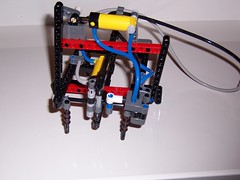 When I realized I'd have only one week between LEGOPalooza and Robot Rumble in which to build a new robot, I decided I needed to pick a small project to do. Having already sized up the 2010 LEGO TECHNIC Log Loader (8049) kit to determine that it included the necessary pneumatic elements to build a simple pneumatic walker, I decided to try building a walker with that set. So with one week on the clock, the challenge was set: build a functional walker, controlled by a pneumatic circuit, without cutting tubes, and without using any parts that aren't found in that set's box (and at the same time, leaving most of the set's parts still available).
The version brought to Robot Rumble was a bit rough, strained a few parts, and squeaked when certain parts rubbed together (this came in at 100 pieces). A revision was needed (this came in at 109 pieces). I made instructions for both versions (1, 2). I only recommend the second version, which features my later performance improvements. You might be able to make another walker that runs even more smoothly using the parts from this kit, but as far as I am concerned this challenge has been met.
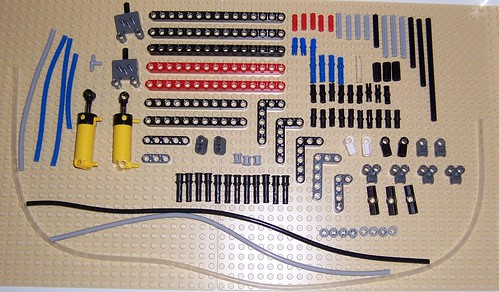
The easiest way to browse the photos that make up the instructions is via flickr. You can come back and read the description of what's going on in this model after you've tried building it (it's alright, it'll still be here).
Pneumatic logic works in much the same way that electronic logic works, but instead of electricity controlling the flow of electricity, pressurized air is controlling the flow of pressurized air. You can actually use LEGO pneumatics parts to build a variety of logic gates. There's nothing stopping you (in theory) from building an entire computer out of nothing but pneumatic logic gates. Personally, I like the pneumatic circuit I used in this model as an extremely primitive example of a two-bit pneumatic counter with no carry-over digit (yes, I'm just that nerdy). When you're limited to this few valves and pistons, though, it's hard to do much in the way of complex circuitry - so you don't really need to understand logic gates to follow what's happening here. Eric Brok documented this sort of pneumatic control system some years ago, and did it in a clear, less nerdy way, complete with color-coded schematics. In my model, the white parts show you where a piston is connected to a valve, and the pistons control each other's valves like in Eric's first illustration.
Pneumatic walkers were once considered something of a fad and a classic project among LEGO Technic fans. Pneuma-Ped is a good example of a somewhat more complex model, but some of the ones on LUGNET's list are much more ambitious (also, expensive and parts-intensive - the difficulty of getting pneumatic elements at a good price is part of why I set this challenge to myself to use only parts from one kit that's currently widely available).
I highly recommend buying this set from one of these two links (I receive a small commission for each kit bought through these links):
Buy LEGO TECHNIC Log Loader (8049) via LEGO Shop-at-Home
Buy LEGO TECHNIC Log Loader (8049) via Amazon

If you want to try something similar without this kit, or buy additional parts to build a more complex machine like this one, you can order parts online. Some LEGO pneumatic elements are currently available (in some cases, exclusively available) through LEGO Education. All manner of LEGO elements can be bought individually through various sellers on BrickLink.
Instructions style and the "take photos as you take it apart" technique blatantly ripped off of http://nxtprograms.com/
My design is fairly similar to one I've blogged previously for LMOTD. Since that builder was working towards a different challenge (building the smallest possible walker), the end result is actually quite different. The similarities come from using it as inspiration - I'm having a hard time recalling if I was inspired by any other two valve / two piston walkers, but I liked the hexapod mechanism here and can't seem to locate other simple walker links offhand (if you have links I should share or cite here, feel free to drop me a line at 316danny@gmail.com)
EDIT 4/28/2010: There's now a video of this in action (thanks to Jesse Bikman, who took this video at Maker Faire NC and has added it to that show's flickr pool).
Interesting Links
Time for a new link dump. Are you enjoying these?
The Internet Archive recently announced a new project called OpenLibrary. It's essentially Wikipedia for books. That's still needed, since LibraryThing lacks a good way of summarizing things for people interested in discovering books in a non-social manner (not that there's anything wrong with using social networking to discover interesting books - if you ask me, LibraryThing is an example of social networking done right because it actually uses the social model to purposefully manage meaningful data).
For April Fool's Day, XKCD decided to change the site's format to a command line interface. In addition to commands that were functional (and a few that just appeared to be), there were also jokes and games. That interface is still available for those of you who missed the joke or want to relive it (more than I can say for YouTube's TEXTp feature by the time I blogged about it at LMOTD). Most of the source code (some last minute changes were made during the day) is available on github. Naturally, the next step would be to build a version of this that can be used with YubNub - then you will have a true command line for the web (I'm not up for coding this myself due to lack of time, but I'm definitely excited about the idea).
YubNub is worth trying out anyway, if you're not familiar with it. The description of it on it's website probably isn't appealing to most, but trust me, it's worth it (I intend to revisit the topic in a future post and describe why I think all LEGO fans should use it - type "ls lego" into it if you want a taste of that).
Thursday, April 1, 2010
Recent Photos
I've recently uploaded several bunches of photos on flickr. I decided to give up and go pro. That gives me two years before I need to come up with a better photo solution (although notes and the social aspects of flickr do appeal to me, the thought of needing to pay Flickr/Yahoo! ~$2 a month until the end of time does not).
I'm particularly interested in feedback on the instructions for the pneumatic walker. A finalized version of those will appear soon, and I'd like to see that version be more user friendly in addition to the model itself being more functional.
Here are the new photo sets:
I'm particularly interested in feedback on the instructions for the pneumatic walker. A finalized version of those will appear soon, and I'd like to see that version be more user friendly in addition to the model itself being more functional.
Here are the new photo sets:
- Robot Rumble 2010
- Primitive Walker Concept
- Walker I instructions (this is the one I want feedback on)
- LEGO Technique Studies (I'll probably add to this one occasionally without posting about it here)
- Joe Meno's February/March 2010 WITC
- BrickFair 2009 (previously posted to Brickapolis' flickr account - but I wanted them on mine now that I've gone pro as well)
- LEGOPalooza 2010
- Over the Rhine March 13th 2010 (proof I need concert photo tips)
Wednesday, March 24, 2010
NXT Holonomic Drive Idea
Holonomic drive systems are difficult to build with LEGO. I've never successfully built one myself, but I started to try once and I see it as something that will be increasingly easy to do in the future. You can already see more three-sided elements showing up in current sets that will make this an easier thing to do. I'm hoping that someone with more time to work on this will take it up and be able to use my attempt as a starting point. If you do, let me know and I'll let my readers know.
From my one given-up-on attempt, here's my contribution to this:
The idea: use 3 of these modules (of which I only ever built this one - I doubt that this exact design would actually be able to hold the weight of a frame and a battery box to power it), and only power the ones you need to go a particular direction. The ball will function as an unpowered caster until a motor is turned on in either direction. When the motor turns on, the geared bar swings down and the wheel in the middle will power the ball. This is an extreme take on the poor man's directional transmission concept, and I suspect that it won't work so well once there's more weight on it - but it's an idea. Omni wheels would probably be harder to build but function more smoothly. Personally, I really like the idea of a wheel that can be powered selectively, but I think it would need to be much sturdier and more firmly powered than this.
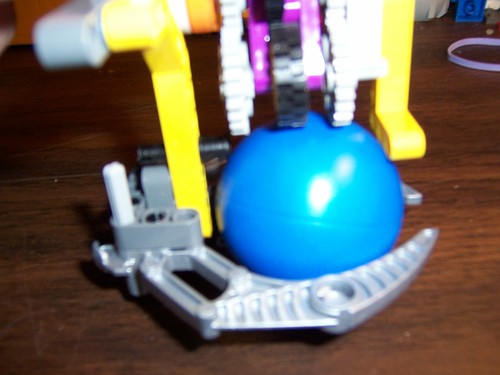
More photos are on flickr (I finally went pro and started cleaning up my account, which is how I remembered I never did blog these photos) at http://www.flickr.com/photos/dp3/sets/72157623684905594/
From my one given-up-on attempt, here's my contribution to this:
The idea: use 3 of these modules (of which I only ever built this one - I doubt that this exact design would actually be able to hold the weight of a frame and a battery box to power it), and only power the ones you need to go a particular direction. The ball will function as an unpowered caster until a motor is turned on in either direction. When the motor turns on, the geared bar swings down and the wheel in the middle will power the ball. This is an extreme take on the poor man's directional transmission concept, and I suspect that it won't work so well once there's more weight on it - but it's an idea. Omni wheels would probably be harder to build but function more smoothly. Personally, I really like the idea of a wheel that can be powered selectively, but I think it would need to be much sturdier and more firmly powered than this.
More photos are on flickr (I finally went pro and started cleaning up my account, which is how I remembered I never did blog these photos) at http://www.flickr.com/photos/dp3/sets/72157623684905594/
Tuesday, March 23, 2010
(Recently Used) Programming Resources
I've been stashing bunches of URLs at work that I've found useful. Some of these I might want to refer to in a non-work context, but they're all based on stuff I've been working with lately (perl, Git, Bash, Cacti, Linux, etc). Nothing too earth-shattering, but very handy. Here's the current list:
Git
Git - SVN Crash Course
Git Cheat Sheet
Perl
Pointers in Perl
Perl Regular Expressions
Perl Tutorial - Arrays
Perl File IO
Yubnub commands: perldoc, cpandoc
Vi (Don't use this often but frequently find myself in there and needto escape):
Vi Cheat Sheet
Simple Guide To VI / VIM
Linux:
The .ssh/known_hosts file
Linux / Unix grep command help
Regular Expressions in grep
Show all running processes
Bash:
How to Write a Shell Script
Bash Self-Extracting Script
Cacti:
Cacti Manual - CLI Scripts
Cacti Documentation
Monday, March 22, 2010
Robot Rumble 2010 Recap
A brief recap from yesterday's show:
Robot Rumble 2010 was a great show. As a LEGO-only person (this time out, anyway) with Triangle Amateur Robotics, I ended up being a bit of a point person for various AFOL-related topics. Although there was a group from IBM calling itself "Lego and Dancing Robotics" (long story short: they build generic 'bots from the NXT Education edition booklet and make them "dance" around. It's an outgrowth of an older educational program that they started a few years back), and there were several FIRST LEGO League teams on hand, I ended up fielding questions about LEGO, NCLUG, LEGOPalooza, and BrickMagic, alongside the more expected TAR, Maker Faire NC, TechShop, pneumatics, programming, and robotics questions. Some of it was influenced by the fact that we were so close to the front of the museum, but overall I feel like it was a good idea to have a dedicated LEGO robotics adult there (no offense - but there's a decided shortage of active LEGO hobbyists in this area who are into the robotics side of things).
The other groups displaying (listed at the official event link above) were alright, although a few were a little anticlimactic - Carolina Combat Robotics spent the day playing robot hockey instead of battle bots (maybe I got the wrong impression from their name...) and iRobot brought out almost the exact same display that they had at the NCSU career fair last year. The IBM group was helpful, since I could refer requests to see my NXT kit in action to their group. One of the IBMers also clued me in to OpenCV, which looks like something I can use with all those Logitech cameras I've been stashing around the house (back when LEGO had a branded version of the Logitech QuickCam and Logitech was still supporting the programming API for the QuickCam, I got excited about the idea of building a serious robot with them and started buying up every one I could find cheap).
My pneumatic walker spent most of the day between a completely homebrew line-follower and a Zhu-zhu pet, which is actually a pretty good metaphor for the range of robots you'll see at TAR. It was fun blowing people's minds with an entirely pneumatic robot - although pneumatic logic is old-hat by the standards of the LEGO fan community (in the late '90's/early '00's, it was something of a classic project and a fad), most people still have never seen a pneumatic walker or heard of a pneumatic logic control circuit. The idea of a system that doesn't need any software is apparently pretty far out of the mainstream of robotics now. Parents and kids, on the other hand, were pretty thrilled with this - here's something you can build and design yourself, with a little thought and less than $60 down into the hobby. A simple $60 walking robot (with almost 500 spare parts afterward) is understandably more appealing than spending ~$250 for an NXT kit and then not knowing quite how to use it and program it (which, of course, is why I intend to post instructions and encourage today's kids and parents to take this project up). Another fun thing I noticed was that kids really loved the pneumatic hand pump. Sure, it was annoying spending ~4 hours of my Saturday pumping up air pressure for my walker, but it was kind of fun to hand it over when kids asked "Can I try?", and then watch as every kid near the booth had a chance to "control" it for a minute or two. During the few times when the walker was unattended, kids were able to figure out how to use the pump and run the 'bot on their own. Next few LEGO shows, I'll have to make a point to have an interactive element controlled by a pump.
I will, as promised, deliver instructions for my pneumatic walker shortly. I've been making some revisions to allow it to run more smoothly, and I'm not entirely sure at the moment when/where I'll be putting photos and instructions online. I may test further - I had taken all the photos I needed to post instructions in the style of nxtprograms.com before, but then I realized I needed to work on reliability so that this would be ready for hours of use. I'll probably put off doing another round of instruction photos until I've worked out those kinks.
Expect event photos to show up online around the same time.
Subscribe to:
Posts (Atom)